

Industrial Diagnostic Tools Market to Reach USD 76.9 Billion by 2036 as Governance-Driven Maintenance Accelerates
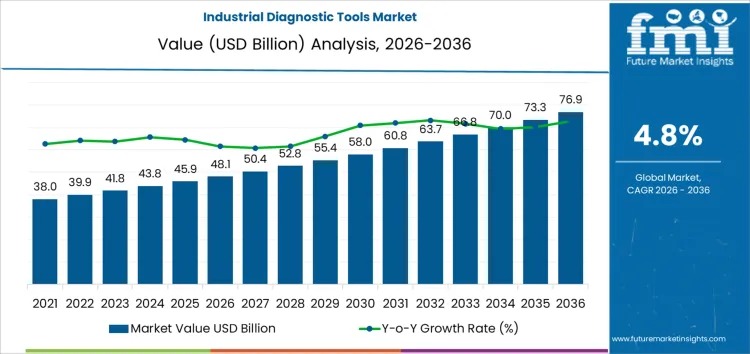
Industrial Diagnostic Tools Market
Industrial diagnostic tools gain traction as organizations formalize asset governance, driving steady global growth through 2036.
NEWARK, DE, UNITED STATES, February 4, 2026 /EINPresswire.com/ -- Industrial Diagnostic Tools Industry Outlook: From Troubleshooting to Strategic Governance
The Industrial Diagnostic Tools Market is undergoing a fundamental transformation as industrial organizations redefine how they manage assets, risks, and accountability. The market is projected to grow from USD 48.1 billion in 2026 to USD 76.9 billion by 2036, registering a CAGR of 4.8%. This growth is driven not by higher inspection frequency alone, but by the formal integration of diagnostics into governance, audit readiness, and cross-site operational decision-making.
As experienced technicians retire and maintenance teams become centralized, plants increasingly depend on tools that deliver standardized, reviewable, and comparable evidence. Diagnostic measurement is now a foundation for reporting and compliance, extending well beyond localized fault detection.
Key market indicators include:
- Market value of USD 48.1 billion in 2026
- Forecast valuation of USD 76.9 billion by 2036
- Steady CAGR of 4.8% over the forecast period
Request For Sample Report | Customize Report | Purchase Full Report–
https://www.futuremarketinsights.com/reports/sample/rep-gb-31302
Deployment Trends Reflect Organizational Restructuring
Deployment patterns for industrial diagnostic tools are evolving in response to changes in how maintenance and reliability functions are organized. Large industrial groups are increasingly establishing centralized engineering and reliability teams responsible for analyzing data from multiple facilities. This shift elevates the importance of consistent measurement formats, standardized procedures, and long-term data continuity across sites.
Smaller facilities, by contrast, adopt diagnostic tools selectively, often driven by external audits, insurance requirements, or customer mandates. In these cases, purchasing decisions are shaped as much by training requirements, certification standards, and documentation output as by the hardware itself.
Adoption dynamics are influenced by:
- Centralized reliability engineering models
- Cross-site performance benchmarking
- Audit, insurer, and compliance-driven procurement
How Diagnostic Tools Improve Reliability and Operational Visibility
Industrial diagnostic tools now play a critical role in predictive maintenance and equipment health assessment across manufacturing, energy, and process industries. Traditional inspection methods, reliant on periodic manual checks, frequently failed to identify early-stage faults. Modern tools integrate vibration analysis, thermal imaging, ultrasonic testing, and real-time analytics to deliver actionable insights and early warnings.
These capabilities enable operators to reduce unplanned downtime, extend asset life, and improve safety outcomes. As cost pressures intensify, organizations prioritize diagnostic solutions that combine measurement accuracy with data integration and usability.
Operational benefits driving adoption include:
- Early anomaly detection and failure prevention
- Improved maintenance scheduling and uptime
- Data-driven operational and safety decisions
Tool Type Demand Shaped by Failure Pathways
Demand across diagnostic tool categories is shaped less by technology roadmaps and more by how failures are experienced and investigated. Vibration analyzers account for the largest share of market demand, typically justified after bearing or gearbox failures that are easy to quantify financially. Thermal imagers often enter facilities through electrical safety programs and fire-risk audits, while ultrasonic tools are adopted following compressed air or steam loss assessments.
Portable spectrum analyzers remain specialist tools, acquired primarily after complex root-cause investigations. Each category corresponds to a distinct institutional trigger for spending.
Tool adoption is commonly driven by:
- Incident investigations and downtime losses
- Safety audits and insurance inspections
- Regulatory and compliance pressures
Manufacturing Emerges as the Largest End-Use Segment
Manufacturing accounts for approximately 45% of industrial diagnostic tools demand, driven by the frequency of small and medium-scale failures across decentralized production sites. Unlike oil and gas or power generation, where failures are rarer but more expensive, manufacturing environments generate continuous, recurring diagnostic needs.
This fragmentation creates thousands of independent buying centers, each responding to localized incidents, audits, and operational pressures. As a result, manufacturing remains the most consistent and resilient demand driver for the market.
Manufacturing dominance is supported by:
- High equipment density and uptime sensitivity
- Decentralized procurement structures
- Continuous improvement and audit cycles
Regional Growth Highlights Emerging Market Momentum
Asia Pacific leads global growth, with India recording a CAGR of 5.5% and China 5.2%, supported by industrial expansion and modernization initiatives. North America and Europe show steady growth as diagnostic tools become embedded in predictive maintenance and compliance programs. Across regions, distributor networks, service coverage, and calibration support strongly influence brand selection.
Growth is increasingly tied to service ecosystems rather than standalone equipment sales.
Competitive Landscape Focuses on Integrated Ecosystems
Leading players including Fluke Corporation, SKF, Honeywell International, Siemens, and Emerson compete through accuracy, interoperability, and analytical depth. While handheld instruments remain critical, long-term differentiation increasingly comes from integrated ecosystems that support data continuity, analytics, and cross-site standardization.
Suppliers aligned with evidence-based governance and disciplined reliability programs are best positioned to capture sustained demand.
Get data that aligns with your strategic priorities — ask for report customization today:
https://www.futuremarketinsights.com/customization-available/rep-gb-31302
Related Reports
Demand for Temporary Fencing Panels in USA- https://www.futuremarketinsights.com/reports/united-states-temporary-fencing-panels-market
Demand for Solar Attic Fans in USA- https://www.futuremarketinsights.com/reports/united-states-solar-attic-fans-market
Demand for Solar Air Conditioning System in USA- https://www.futuremarketinsights.com/reports/united-states-solar-air-conditioning-system-market
Have a specific Requirements and Need Assistant on Report Pricing or Limited Budget please contact us - sales@futuremarketinsights.com
About Future Market Insights (FMI)
Future Market Insights, Inc. (FMI) is an ESOMAR-certified, ISO 9001:2015 market research and consulting organization, trusted by Fortune 500 clients and global enterprises. With operations in the U.S., UK, India, and Dubai, FMI provides data-backed insights and strategic intelligence across 30+ industries and 1200 markets worldwide.
Contact Us:
Future Market Insights Inc.
Christiana Corporate, 200 Continental Drive,
Suite 401, Newark, Delaware - 19713, USA
T: +1-347-918-3531
Why FMI: https://www.futuremarketinsights.com/why-fmi
For Sales Enquiries: sales@futuremarketinsights.com
Website: https://www.futuremarketinsights.com
LinkedIn| Twitter| Blogs | YouTube
Sudip Saha
Future Market Insights Inc.
+1 347-918-3531
email us here
Legal Disclaimer:
EIN Presswire provides this news content "as is" without warranty of any kind. We do not accept any responsibility or liability for the accuracy, content, images, videos, licenses, completeness, legality, or reliability of the information contained in this article. If you have any complaints or copyright issues related to this article, kindly contact the author above.
