

Industrial Hemp Market Outlook: From USD 13.86 Billion in 2026 to USD 71.53 Billion by 2034, exhibiting a CAGR of 22.77%
Industrial Hemp Market
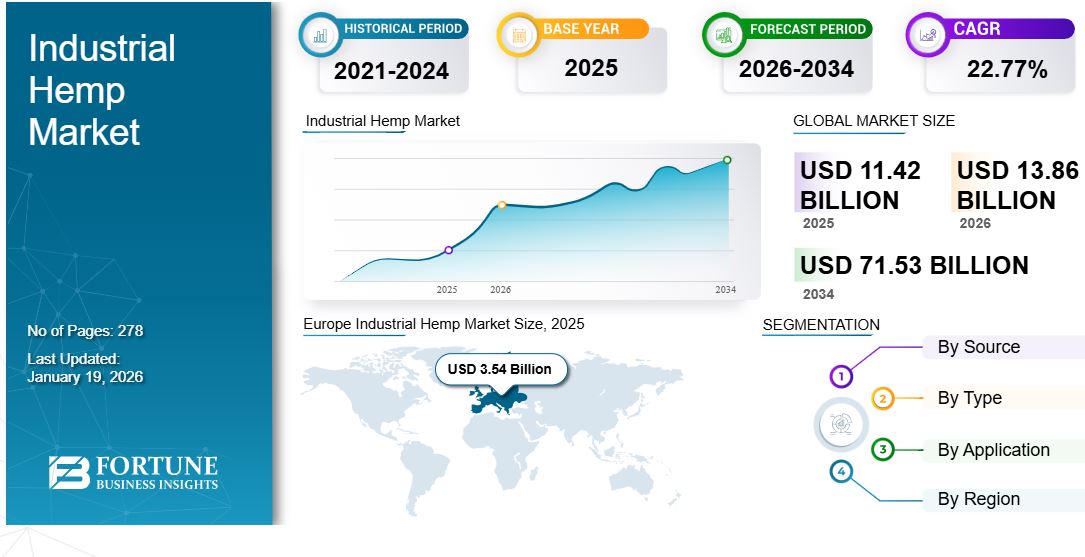
The global industrial hemp market was valued at USD 11.42 billion in 2025 and is projected to grow from USD 13.86 billion in 2026 to USD 71.53 billion by 2034.
PUNE, INDIA, February 7, 2026 /EINPresswire.com/ -- The global industrial hemp market was valued at USD 11.42 billion in 2025 and is projected to grow from USD 13.86 billion in 2026 to USD 71.53 billion by 2034, exhibiting a CAGR of 22.77% during the forecast period. Europe dominated the industrial hemp market with a share of 30.96% in 2025, supported by large-scale cultivation and well-established processing infrastructure.Industrial hemp, a variety of Cannabis sativa with low tetrahydrocannabinol (THC) content, offers exceptional versatility. Hemp seeds, fiber, and oil are increasingly used as alternatives to synthetic and petroleum-based materials, aligning with global sustainability goals. Additionally, rising awareness regarding the functional and therapeutic benefits of hemp-derived cannabidiol (CBD), including stress relief, pain management, and anti-inflammatory effects, is strengthening demand across nutraceutical and pharmaceutical applications.
Get Free Sample Research Report:
https://www.fortunebusinessinsights.com/enquiry/request-sample-pdf/industrial-hemp-market-102459
Top Companies in Industrial Hemp Market
• Fresh Hemp Foods Ltd.
• IND HEMP, LLC
• Blue Sky Hemp Ventures
• Panda Biotech, LLC
• Hemp Republic
• HempFlax Group B.V.
• South Hemp Tecno Srl
• DON Processing, Inc.
Industrial Hemp Market Trends
One of the most prominent trends in the industrial hemp market is the introduction of innovative hemp-based construction and insulation materials such as lime hemp concrete, fiber-board insulation, and hemp wool. These materials offer superior thermal insulation, moisture regulation, and carbon-sequestration properties, making them highly attractive for green building applications. Hemp concrete, in particular, continues to store carbon throughout a building’s life cycle, supporting net-zero construction objectives.
Another important trend is the development of value-added hemp-derived ingredients for cosmetics, personal care, and nutraceutical products. Manufacturers are increasingly incorporating hemp seed oil and CBD into moisturizers, shampoos, serums, and wellness supplements due to their moisturizing, antioxidant, and anti-inflammatory properties.
The textile industry is also witnessing a shift toward hemp fiber as brands seek sustainable alternatives to cotton and synthetic fibers. Hemp textiles require less water, fewer pesticides, and offer high durability, making them suitable for eco-conscious apparel and home furnishing applications.
Industrial Hemp Market Growth Factors
The rapid expansion of the industrial hemp market is strongly supported by increasing legalization and favorable government policies. Several countries have legalized industrial hemp cultivation and raised permissible THC limits to stimulate production. For example, the European Union increased the allowable THC level in industrial hemp crops to 0.3%, encouraging wider cultivation.
Rising international trade of hemp and hemp-derived products is another major growth driver. Countries where hemp cultivation is restricted increasingly rely on imports to meet demand across textiles, food, pharmaceuticals, and cosmetics. Manufacturers are forming cross-border partnerships and licensing agreements to expand global distribution networks.
In addition, strong consumer interest in plant-based nutrition is boosting demand for hemp-based food products such as protein powders, hemp milk, snacks, and functional foods. Hemp seeds offer high-quality protein, omega-3 and omega-6 fatty acids, vitamins, and minerals, making them attractive to health-conscious and vegan consumers.
Despite these drivers, market growth may be restrained by complex and inconsistent regulatory frameworks governing hemp, CBD, and THC across different countries and states. Uncertainty around approvals for CBD in foods and dietary supplements, as well as restrictions in certain cosmetic applications, can limit product commercialization.
Industrial Hemp Market Segmentation Analysis
By source, the market is segmented into organic and conventional. The conventional segment is projected to hold a dominant share of 64.64% in 2026, driven by lower production costs and broader availability. Conventional hemp is widely used in industrial applications such as construction materials, bioplastics, furniture, and textiles. Meanwhile, the organic segment is expected to grow at a faster pace due to increasing consumer preference for chemical-free, sustainably produced products.
By type, the market includes hemp seed, hemp seed oil, hemp fiber, and others. Hemp fiber leads the market with a share of 32.18% in 2026, owing to its extensive use in textiles, automotive composites, paper, and insulation materials. Hemp seed oil is anticipated to register strong growth, supported by its rising use in pharmaceuticals, cosmetics, and functional foods.
By application, the market is segmented into food, beverages, personal care & cosmetics, textiles, pharmaceuticals, and others. The textiles segment dominates with a 31.02% share in 2026, driven by sustainability initiatives and demand for eco-friendly fabrics. Personal care & cosmetics represent one of the fastest-growing segments, as consumers increasingly seek natural ingredients. The food segment is also expanding rapidly, fueled by rising veganism and demand for plant-based proteins.
Speak to Analyst:
https://www.fortunebusinessinsights.com/enquiry/speak-to-analyst/industrial-hemp-market-102459
Regional Insights
Europe leads the global industrial hemp market, with a market size of USD 3.54 billion in 2025. The region benefits from strong agricultural traditions, supportive regulations, and large-scale cultivation in countries such as France and the Netherlands. France alone accounts for over 70% of European hemp production.
North America represents a significant growth region, driven by widespread application of hemp across food, pharmaceuticals, textiles, and construction. The U.S. market is projected to reach USD 2.38 billion by 2026, supported by increasing cultivation acreage and rising domestic processing capacity.
Asia Pacific is emerging as a key production and export hub, led by China, which is one of the world’s largest producers of industrial hemp fiber. Japan, China, and India are witnessing increasing adoption across textiles and personal care products.
South America, the Middle East, and Africa are expected to witness steady growth as governments gradually liberalize hemp regulations and promote industrial and medical applications. South Africa is emerging as a promising African market due to favorable climate conditions and regulatory support.
Key Industry Developments
January 2023: Bast Fibre Technologies Inc. acquired Lumberton Cellulose LLC to expand natural fiber processing capacity in North America.
December 2022: InterCure Ltd. signed a licensing agreement with Binske to market and manufacture branded hemp-based products in Australia, the U.K., Israel, and Germany.
September 2022: The Thai Industrial Hemp Trade Association signed a cooperation agreement with twelve manufacturing associations to promote hemp technologies and innovations.
Related Reports
Hemp Fiber Market Size, Share & Industry Analysis
Hemp Milk Market Size, Share, 2034
Ashwin Arora
Fortune Business Insights™ Pvt. Ltd.
+1 833-909-2966
sales@fortunebusinessinsights.com
Visit us on social media:
LinkedIn
Facebook
X
Legal Disclaimer:
EIN Presswire provides this news content "as is" without warranty of any kind. We do not accept any responsibility or liability for the accuracy, content, images, videos, licenses, completeness, legality, or reliability of the information contained in this article. If you have any complaints or copyright issues related to this article, kindly contact the author above.
