

Tactical Communication Market to Reach USD 41.89 Billion by 2032, Growing at 6.9% CAGR Globally
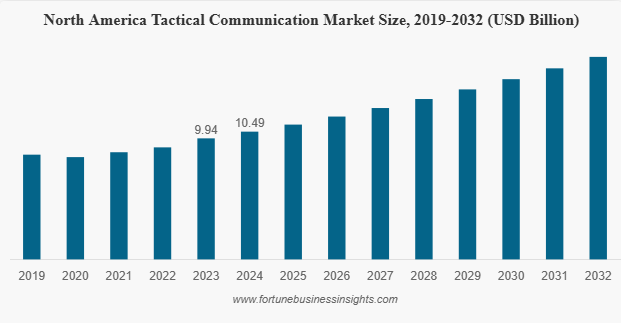
Global tactical communication market growth driven by defense modernization and rising demand for secure real-time battlefield connectivity.
PUNE, MAHARASHTRA, INDIA, February 7, 2026 /EINPresswire.com/ -- The global tactical communication market is witnessing steady expansion as defense forces worldwide modernize their communication infrastructure to support network-centric and multi-domain military operations. According to Fortune Business Insights, the market was valued at USD 24.53 billion in 2024 and is projected to grow from USD 26.19 billion in 2025 to USD 41.89 billion by 2032, registering a compound annual growth rate (CAGR) of 6.9% during the forecast period.Market Overview
Tactical communication systems enable the secure exchange of voice, data, and video among military units, command centers, and allied forces operating in hostile and dynamic environments. These systems are designed to function reliably under harsh conditions, supporting real-time coordination, intelligence sharing, and mission execution. Modern tactical communication platforms integrate advanced encryption, anti-jamming capabilities, and software-defined radio (SDR) technologies to ensure operational continuity and information security.
The increasing complexity of modern warfare, characterized by hybrid threats, cyber warfare, and electronic warfare, has elevated the importance of resilient and interoperable communication networks. Governments are investing heavily in digital battlefield programs and next-generation command and control architectures to improve situational awareness and decision-making speed. These investments are directly driving demand for advanced tactical communication solutions across land, air, naval, and space-based platforms.
Request a sample PDF:-
https://www.fortunebusinessinsights.com/enquiry/request-sample-pdf/tactical-communication-market-114608
Market Segmentation
By platform, the market is segmented into land-based systems, airborne systems, naval systems, and space-based systems. Land-based systems dominate the market, driven by their extensive use across infantry units, armored vehicles, and field command posts. These systems form the backbone of ground-force operations, enabling real-time coordination and battlefield management.
By installation type, the market is categorized into man-portable, vehicle-mounted, aircraft-integrated, shipborne/submarine systems, and fixed command post systems. The man-portable segment holds the largest share due to rising demand for lightweight, mobile communication systems that allow dismounted soldiers to remain connected in fast-changing combat environments. These systems are critical for frontline operations and tactical edge connectivity.
By communication type, the market is segmented into voice communication systems, data communication systems, and video communication systems. Voice communication systems continue to dominate the market, as instant voice exchange remains the most reliable and essential method for command and control in combat scenarios. However, data and video communication systems are gaining traction as militaries increasingly rely on real-time intelligence, surveillance feeds, and sensor data.
By technology, the market includes Software-Defined Radios (SDR), SATCOM, Line-of-Sight (LOS) radio systems, Beyond-Line-of-Sight (BLOS) systems, and others. The SDR segment holds the leading position due to its flexibility, allowing forces to reconfigure frequencies, waveforms, and encryption protocols through software upgrades, improving interoperability and future-proofing communication networks.
By component, the market is segmented into transceivers & antennas, headsets, terminals, handheld radios, and others. Transceivers and antennas dominate the segment as they are core components required for secure transmission and reception of tactical communications.
By frequency band, the market includes HF, VHF, UHF, and SHF/EHF. The UHF band dominates due to its ability to support high-speed data, secure voice, and integration with satellite and airborne communication systems.
By end user, the market is segmented into ground forces, airborne units, maritime forces, and others. Ground forces account for the largest share due to large-scale troop deployments and extensive use of tactical radios and mobile command systems.
Key Players
The tactical communication market is characterized by the presence of major global defense and communication technology companies. Leading players include L3Harris Technologies, Thales Group, BAE Systems, Collins Aerospace, Elbit Systems, and Rohde & Schwarz.
Other prominent players include General Dynamics Mission Systems, Leonardo S.p.A., ASELSAN A.S., Indra Sistemas S.A., and Bharat Electronics Limited. These companies compete based on technological innovation, system interoperability, cybersecurity capabilities, and long-term defense contracts.
Speack To Analyst:-
https://www.fortunebusinessinsights.com/enquiry/speak-to-analyst/tactical-communication-market-114608
Report Coverage
The Fortune Business Insights report provides a comprehensive analysis of the tactical communication market across platforms, installation types, communication types, technologies, components, frequency bands, applications, end users, and regions. The study period spans from 2019 to 2032, with 2024 as the base year and 2025 as the estimated year.
Drivers and Restraints
A major driver of the tactical communication market is the rising demand for real-time situational awareness. Modern military operations rely on instant access to intelligence, surveillance, and reconnaissance (ISR) data, requiring robust communication networks to support rapid decision-making.
Another key driver is the growing adoption of software-defined radios and network-centric warfare architectures. These systems provide enhanced flexibility, interoperability, and cybersecurity, making them essential for multi-domain operations involving joint and coalition forces.
However, high integration complexity and legacy system compatibility issues act as significant restraints. Many defense organizations still operate older analog or proprietary systems that are difficult to integrate with modern digital and IP-based architectures. This creates interoperability challenges and increases the cost and time required for large-scale upgrades.
Regional Insights
North America dominates the global tactical communication market, accounting for 42.76% market share in 2024. The region’s leadership is driven by high defense spending, advanced digital battlefield programs, and large-scale modernization initiatives in the United States.
Europe represents the second-largest regional market, supported by strong defense investments in countries such as Germany, the U.K., and France. European nations are focusing on improving joint-force interoperability and upgrading legacy communication systems to meet NATO standards.
Asia Pacific is expected to witness strong growth during the forecast period, driven by rising defense budgets and modernization programs in China, India, Japan, South Korea, and Australia. These countries are investing in indigenous SDR development, satellite-based communication systems, and advanced command and control platforms.
The Middle East and Rest of the World are also expected to grow steadily, supported by border security programs, counterterrorism operations, and investments in advanced defense communication infrastructure.
Key Industry Developments
In March 2024, Elbit Systems announced new export contracts for its E-LynX software-defined radio platform to support digital battlefield transformation projects in NATO member countries.
Related Reports:-
Geospatial Solutions Market
Push-To-Talk over Cellular (PoC) Market
Wireless Infrastructure Market
Ashwin Arora
Fortune Business Insights™ Pvt. Ltd.
+1 833-909-2966
sales@fortunebusinessinsights.com
Legal Disclaimer:
EIN Presswire provides this news content "as is" without warranty of any kind. We do not accept any responsibility or liability for the accuracy, content, images, videos, licenses, completeness, legality, or reliability of the information contained in this article. If you have any complaints or copyright issues related to this article, kindly contact the author above.
