

Vascular Sealant Market to Hit USD 3.15 Billion by 2036 as Outcome-Driven Surgery Accelerates Adoption
Vascular Sealant Market
Rising vascular and cardiac procedures, coupled with outcome-focused care models, are driving steady global demand for advanced vascular sealants.
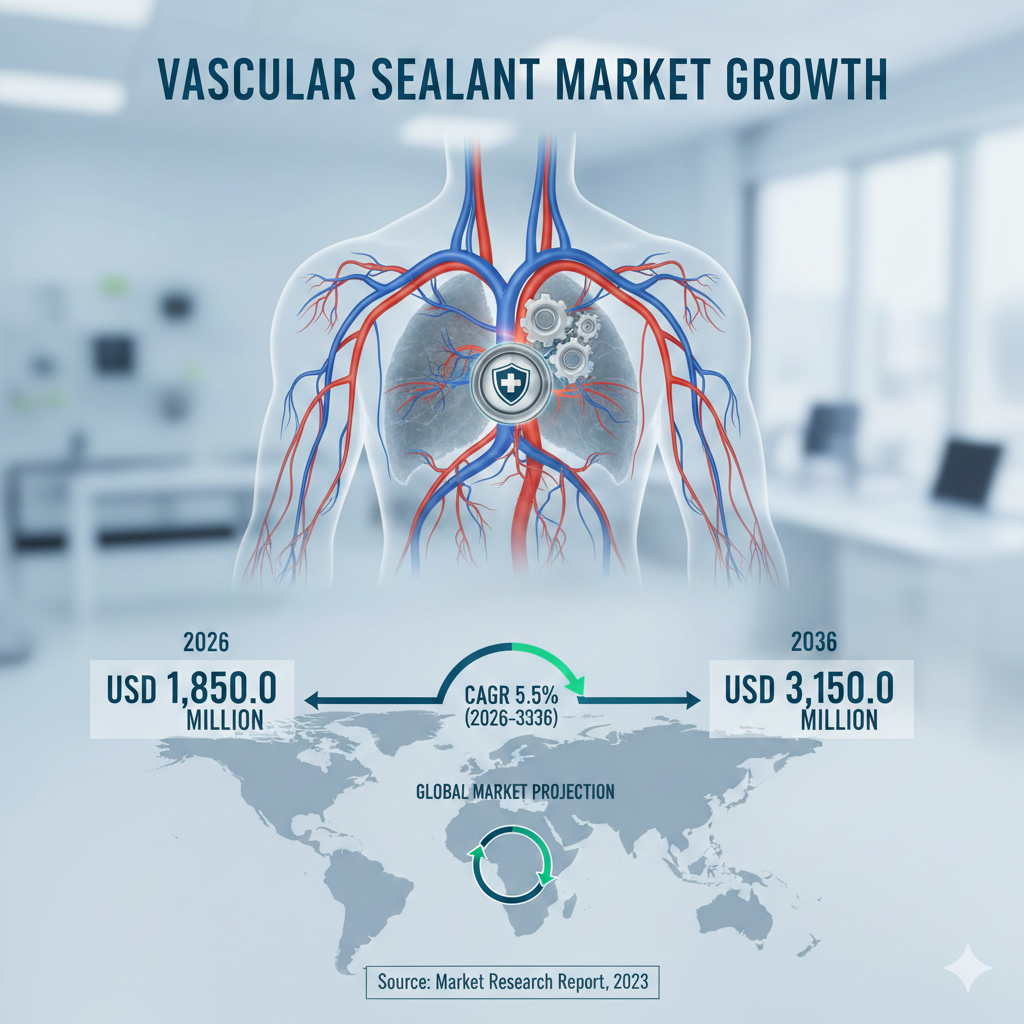
NEWARK, DE, UNITED STATES, February 6, 2026 /EINPresswire.com/ -- The global vascular sealant market is entering a phase of structurally driven growth as surgical teams worldwide increasingly prioritize predictable bleeding control, faster procedures, and reduced post-operative complications. According to Future Market Insights (FMI), the market is projected to reach USD 1,850.0 million in 2026 and expand to USD 3,150.0 million by 2036, registering a steady CAGR of 5.5% over the forecast period.
Growth is being propelled by the rising volume of vascular, endovascular, and cardiac procedures, alongside the expanding role of sealants as standardized adjuncts rather than discretionary tools. Surgeons are increasingly adopting fibrin-based, collagen-based, PEG-based synthetic, and cyanoacrylate sealants to complement sutures and staples, particularly in high-pressure vascular environments where consistency and speed matter most.
The emphasis on intraoperative efficiency and post-procedural outcome reliability has elevated vascular sealants from supportive products to workflow-enabling technologies. Improvements in sealant composition, applicator design, and delivery systems are allowing clinicians to achieve reliable sealing across open, hybrid, and minimally invasive procedures.
Explore trends before investing – request a sample report today! https://www.futuremarketinsights.com/reports/sample/rep-gb-31869
Innovation and Strategic Consolidation Reshape Competitive Dynamics
Large medical technology firms are strengthening their positions through targeted innovation and acquisitions. In January 2026, Haemonetics Corporation announced the acquisition of Vivasure Medical Limited, enhancing its portfolio of percutaneous vessel closure technologies for large-bore and structural heart procedures.
“Acquiring Vivasure expands Haemonetics' complete range of closure devices with new and clinically differentiated technology to bolster our presence in the large-bore closure market,” said Ken Crowley, Vice President & General Manager, Interventional Technologies at Haemonetics.
Baxter International continues to lead the fibrin-based sealant segment, particularly in open vascular and cardiovascular surgery. Johnson & Johnson (Ethicon) and Medtronic are advancing adjunctive sealant solutions aligned with their broader surgical and cardiovascular portfolios. Meanwhile, B. Braun, CSL Behring, and Grifols are expanding biologic and plasma-derived sealant offerings, reinforcing the industry’s shift toward integrated hemostasis and sealing platforms.
Hospitals Remain the Primary Demand Engine
Demand for vascular sealants is still largely concentrated in hospitals, supported by increasing procedural volumes and the adoption of advanced surgical adjuncts. Sealants are widely used for:
• Anastomotic sealing
• Graft reinforcement
• Needle-hole bleeding control
• Adjunct soft-tissue sealing
• Access-site management
Both open vascular surgery and endovascular or hybrid procedures are contributing to rising utilization, particularly as institutions seek to standardize outcomes and reduce variability in bleeding control.
Market Structure and Segment Performance
FMI’s bottom-up analysis maps revenues across sealant chemistry, form factor, use case, clinical setting, and end-user categories. Fibrin-based sealants dominate with a 34.0% market share, owing to their biomimetic mechanism and predictable performance in high-pressure arterial and venous settings. These products remain the benchmark for newer synthetic and hybrid formulations.
By use case, anastomotic sealing accounts for 36.0% of total demand, reflecting the critical importance of leak prevention at vascular junctions to minimize re-interventions and post-operative complications.
The market is segmented by:
Chemistry: Fibrin-based, PEG-based synthetic, cyanoacrylates, collagen/gelatin-based, and others
Form factor: Liquid, patch, spray/foam, pre-filled applicator kits
End user: Hospitals, ambulatory surgery centers, specialty cardiac and vascular centers
Regional Growth Patterns Reflect Clinical and Economic Maturity
Geographically, the United States holds the largest market share, supported by high intervention volumes, mature cardiovascular infrastructure, and strong adoption of protocol-driven adjunct technologies. The U.S. market is expected to grow at a 5.9% CAGR through 2036.
China and Saudi Arabia represent the fastest-growing markets, with projected CAGRs of 6.7% and 6.2%, respectively. In China, rapid expansion of surgical infrastructure and minimally invasive procedures in tertiary hospitals is accelerating sealant adoption. Saudi Arabia’s growth is being driven by healthcare modernization and investment in advanced cardiovascular centers.
Germany (4.8% CAGR), the UK (4.6%), France (4.4%), and Japan (3.9%) reflect more controlled but stable growth, shaped by standardized surgical practices, value-based care frameworks, and cautious technology adoption.
Outcome Accountability Drives Long-Term Adoption
Across regions, the shift toward outcomes-driven and value-based care is reshaping sealant selection criteria. Surgeons and healthcare systems are prioritizing products with proven clinical performance, predictable degradation profiles, and compatibility with existing workflows. Sealants are increasingly evaluated not only for hemostatic efficacy, but also for their impact on recovery time, complication avoidance, and resource utilization.
Dive deeper—click here for the comprehensive report. https://www.futuremarketinsights.com/reports/brochure/rep-gb-31869
Competitive Landscape and Recent Developments
The competitive environment is defined by versatility, ease of use, and applicability across open and minimally invasive procedures. Key players active in the market include Baxter International, Johnson & Johnson (Ethicon), Medtronic, B. Braun, CSL Behring, Grifols, Integra LifeSciences, Artivion (CryoLife), Smith+Nephew, and Teleflex. Ongoing acquisitions and portfolio expansion continue to reinforce the role of vascular sealants as core components of modern surgical infrastructure.
Key Players in the Vascular Sealant Market
Baxter International
Johnson & Johnson (Ethicon)
Medtronic
B. Braun
CSL Behring
Grifols
Integra LifeSciences
Artivion (CryoLife)
Smith+Nephew
Teleflex
Browse Related Reports
Vascular Endothelial Growth Factor Inhibitor Market: https://www.futuremarketinsights.com/reports/vascular-endothelial-growth-factor-inhibitor-market
Vascular Imaging Systems Market: https://www.futuremarketinsights.com/reports/vascular-imaging-systems-market
Vascular Closure Devices Market: https://www.futuremarketinsights.com/reports/vascular-closure-devices-market
About Future Market Insights (FMI)
Future Market Insights, Inc. (FMI) is an ESOMAR-certified, ISO 9001:2015 market research and consulting organization trusted by Fortune 500 companies worldwide. With operations in the U.S., UK, India, and Dubai, FMI provides strategic insights across 30+ industries and 1,200+ global markets.
Sudip Saha
Future Market Insights Inc.
+18455795705 ext.
email us here
Legal Disclaimer:
EIN Presswire provides this news content "as is" without warranty of any kind. We do not accept any responsibility or liability for the accuracy, content, images, videos, licenses, completeness, legality, or reliability of the information contained in this article. If you have any complaints or copyright issues related to this article, kindly contact the author above.
