

Global Fabric Stain Remover Market to Hit USD 19.3B by 2036, Led by Asia-Pacific & P&G, Unilever, Reckitt
Fabric Stain Remover Market
Global fabric stain remover market grows at 4.7% CAGR, driven by Asia-Pacific demand, liquid formats, and innovation by P&G, Unilever & Henkel
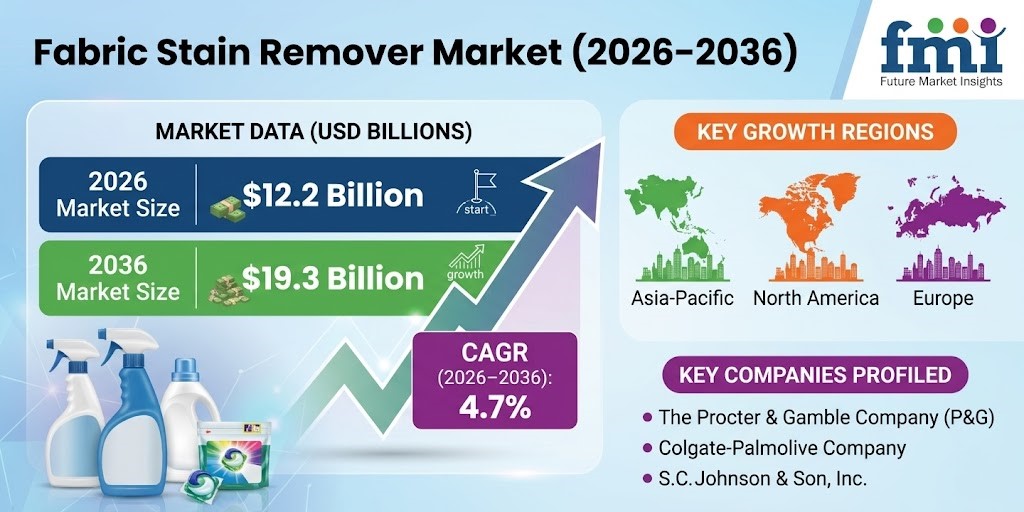
NEWARK, DE, UNITED STATES, March 27, 2026 /EINPresswire.com/ -- The global fabric stain remover market is projected to grow steadily over the next decade, expanding from USD 12.2 billion in 2026 to USD 19.3 billion by 2036, registering a CAGR of 4.7%. According to the latest analysis, market expansion is increasingly driven by product performance, brand strength, and pricing discipline rather than sheer volume growth.
As consumption stabilizes across developed regions, manufacturers are shifting focus toward premium formulations, enzyme-based solutions, and higher per-household usage to sustain revenue growth and profitability.
Fabric Stain Remover Market Snapshot (2026–2036)
• Market size in 2026: USD 12.2 billion
• Market size in 2036: USD 19.3 billion
• CAGR (2026–2036): 4.7%
• Leading product type: Liquid stain removers (~67% share)
• Dominant sales channel: Online retail (~73% share)
• Key growth regions: Asia-Pacific, North America, Europe
• Fastest-growing countries: India, China, Canada, United Kingdom, United States
Request For Sample Report | Customize Report |purchase Full Report – https://www.futuremarketinsights.com/reports/sample/rep-gb-8431
Market Momentum
The fabric stain remover market begins at USD 12.2 billion in 2026 and follows a stable growth trajectory through the forecast period. By 2030, steady demand for high-performance and cold-wash compatible products pushes the market toward sustained expansion.
Between 2030 and 2036, growth is reinforced by advancements in enzyme-based formulations, increased compatibility with smart washing machines, and expansion of subscription-based and e-commerce sales models. By 2036, the market reaches USD 19.3 billion, maintaining a consistent CAGR of 4.7%.
Why the Market Is Growing
Growth in the fabric stain remover market is increasingly tied to formulation innovation and changing consumer laundry behaviors. Enzyme-driven solutions using proteases, lipases, and amylases are enhancing stain removal efficiency across protein, oil, and starch-based stains.
Cold-water washing trends are playing a critical role, with consumers prioritizing energy efficiency and shorter wash cycles. Liquid stain removers, which perform effectively at low temperatures (15–20°C), are gaining widespread adoption.
Additionally, the rise of AI-enabled washing machines with automated dosing systems is influencing product development. Liquid formats are preferred due to their compatibility with precision dispensing technologies, ensuring optimal usage and improved cleaning performance.
Segment Spotlight
Product Type: Liquid Stain Removers Lead with ~67% Share
Liquid stain removers dominate the market due to their superior performance in cold-water conditions, faster dispersion, and compatibility with automated dosing systems. These products are particularly effective in short-cycle and energy-efficient washing programs.
Sales Channel: Online Retail Leads (~73% Share)
Online retail channels account for the majority of sales, driven by subscription-based purchasing, auto-replenishment models, and enhanced product discovery through digital platforms. Consumers increasingly rely on e-commerce for convenience, product comparison, and consistent supply.
Regional Growth: Asia-Pacific, North America, and Europe Drive Expansion
Asia-Pacific is expected to be the fastest-growing region, fueled by rising urbanization, expanding middle-class populations, and increased adoption of modern laundry appliances in countries like India and China.
North America remains a key market in terms of value, supported by strong brand presence, innovation in formulation technologies, and widespread adoption of smart home appliances. Europe demonstrates steady growth, driven by regulatory compliance requirements, sustainability initiatives, and demand for high-performance eco-friendly products.
Drivers, Opportunities, Trends, Challenges
Drivers:
• Rising demand for energy-efficient and cold-wash laundry solutions
• Increasing adoption of enzyme-based, high-performance formulations
• Growth of smart washing machines and automated dosing systems
Opportunities:
• Development of bio-based and sustainable surfactants
• Integration with AI-enabled and connected appliance ecosystems
• Expansion of portable stain remover formats (pens, wipes, tablets)
Trends:
• Shift toward liquid and concentrated detergent formats
• Growth in subscription-based and auto-replenishment sales models
• Adoption of Digital Product Passports and traceability systems
Challenges:
• Trade tariffs and raw material cost volatility
• Regulatory compliance requirements (biodegradability, VOC rules)
• Intense competition from private-label and low-cost alternatives
Country Growth Outlook (CAGR 2026–2036)
• India: 12.3% CAGR, driven by rapid urbanization, rising appliance penetration, and demand for short-cycle washing solutions
• China: 10.4% CAGR, supported by premiumization and regulatory-driven formulation changes
• Canada: 6.7% CAGR, fueled by increased adoption of specialized stain removal products and regulatory enforcement
• United Kingdom: 5.9% CAGR, driven by sustainability regulations and brand consolidation
• United States: 5.0% CAGR, reflecting a mature market with growth centered on innovation and performance upgrades
Competitive Landscape
The fabric stain remover market is highly competitive, with leading players focusing on formulation innovation, portfolio optimization, and integration with modern washing technologies.
Key companies include Procter & Gamble, Unilever, Reckitt Benckiser, Henkel, and Church & Dwight.
These companies are investing in enzyme-based formulations, liquid product innovations, and supply chain optimization while strengthening their presence across e-commerce and subscription-based platforms. Strategic divestments and acquisitions are also reshaping portfolios to focus on high-margin, high-performance brands.
Conclusion
The fabric stain remover market is set for steady growth through 2036, driven by advancements in formulation science, the shift toward energy-efficient laundry practices, and increasing integration with smart home technologies. As performance, sustainability, and convenience become central to consumer decision-making, manufacturers that prioritize innovation and adaptability will be best positioned to capture long-term market value.
Why FMI: https://www.futuremarketinsights.com/why-fmi
Explore more research reports by FMI
Integrated Microfibre Filter Assemblies for Household Washing Machines Market: https://www.futuremarketinsights.com/reports/integrated-microfibre-filter-assemblies-for-household-washing-machines-market
Floriculture Market: https://www.futuremarketinsights.com/reports/floriculture-market
Portable Dishwasher Market: https://www.futuremarketinsights.com/reports/portable-dishwasher-market
About Future Market Insights (FMI)
Future Market Insights, Inc. (FMI) is an ESOMAR-certified, ISO 9001:2015 market research and consulting organization, trusted by Fortune 500 clients and global enterprises. With operations in the U.S., UK, India, and Dubai, FMI provides data-backed insights and strategic intelligence across 30+ industries and 1200 markets worldwide.
Sudip Saha
Future Market Insights Inc.
+1 347-918-3531
email us here
Legal Disclaimer:
EIN Presswire provides this news content "as is" without warranty of any kind. We do not accept any responsibility or liability for the accuracy, content, images, videos, licenses, completeness, legality, or reliability of the information contained in this article. If you have any complaints or copyright issues related to this article, kindly contact the author above.
