

High Performance Random Packing Market to Reach USD 826.8 Mn by 2036, Asia Pacific Lead, Koch-Glitsch and Sulzer Compete
High Performance Random Packing Market
USA high-performance random packing market grows at 3.9% CAGR, driven by petrochemical, advanced manufacturing, and efficiency-focused process integration
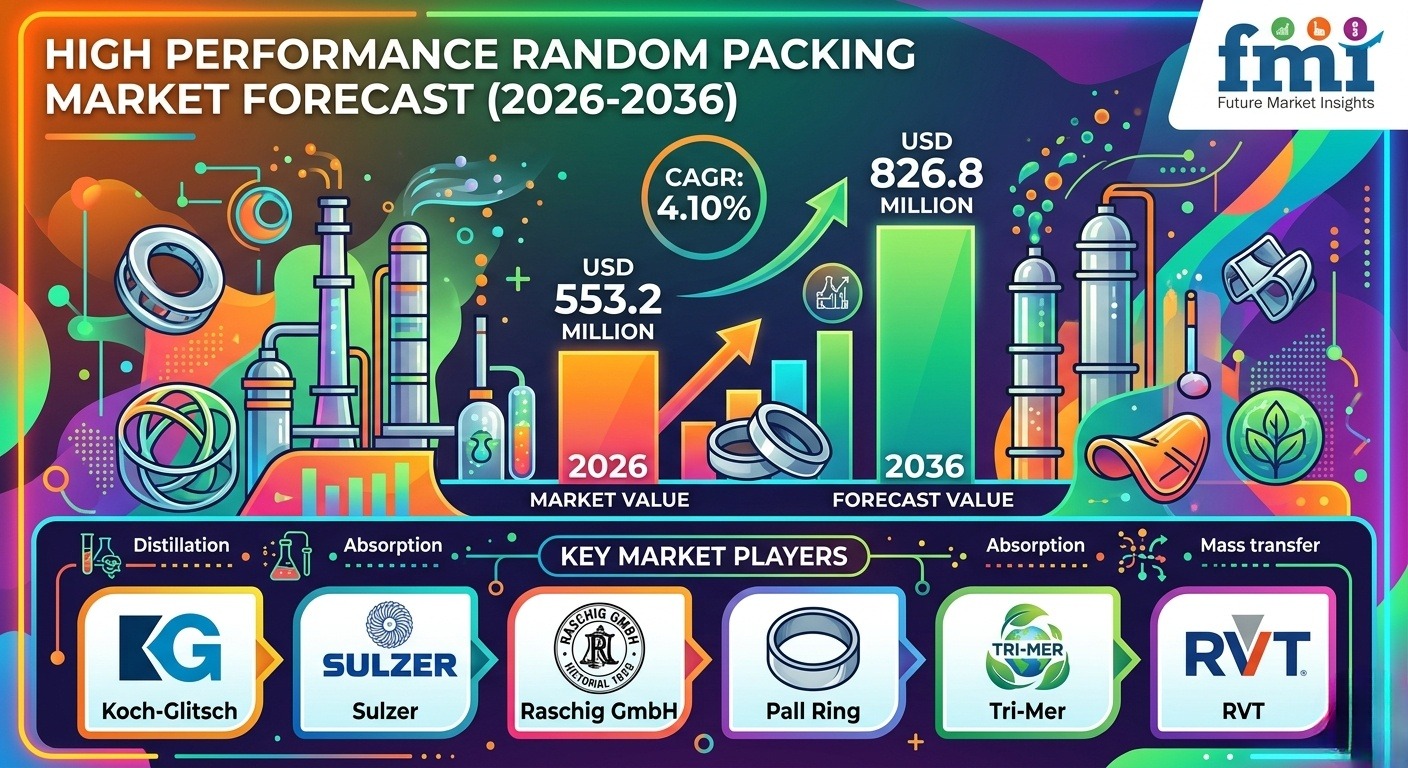
NEWARK, DE, UNITED STATES, March 27, 2026 /EINPresswire.com/ -- The global high performance random packing market is entering a phase of steady yet strategically significant expansion, driven by intensifying demand for process efficiency, environmental compliance, and industrial modernization. Valued at USD 553.2 million in 2026, the market is projected to reach USD 826.8 million by 2036, growing at a CAGR of 4.10%. While growth is moderate compared to high-velocity industrial segments, the category’s critical role in separation processes positions it as an indispensable component of refinery, chemical, and environmental engineering infrastructure worldwide.
According to a comprehensive strategic outlook by Future Market Insights (FMI), the market’s evolution is closely tied to refinery capacity additions, the rise of carbon capture and storage (CCS) projects, and tightening global emission regulations. High performance random packing—used extensively in distillation columns, absorption towers, and scrubbing systems is increasingly being specified as a performance-driven solution rather than a commoditized consumable.
Market Metrics Snapshot (2026–2036)
• Market Value (2026): USD 553.2 million
• Projected Value (2036): USD 826.8 million
• CAGR: 4.10%
• Incremental Opportunity: USD 273.6 million
• Leading Material Segment: Ceramic Random Packing (42% share)
• Top Application Segment: Chemical Industry (35% share)
Discover Market Opportunities – Get Your Sample of Our Industry Overview Today!
https://www.futuremarketinsights.com/reports/sample/rep-gb-27555
The Efficiency Imperative: From Conventional Media to Engineered Performance
The high performance random packing industry is undergoing a material and design transformation as process engineers prioritize efficiency gains and operational optimization. Traditional packing formats such as Raschig rings are being replaced by advanced geometries like IMTP and Nutter rings, which offer significantly improved mass transfer efficiency and lower pressure drop per theoretical stage.
This shift is fundamentally altering procurement strategies. End users are no longer selecting packing based solely on cost, but on lifecycle performance metrics—including energy savings, throughput enhancement, and reduced column diameter requirements.
“Random packing has evolved into a precision-engineered solution,” notes an FMI analyst. “Operators are prioritizing designs that reduce compressor load and improve hydraulic performance, especially in retrofit projects where incremental efficiency gains translate directly into cost savings.”
Carbon Capture: A New Demand Engine
One of the most transformative growth drivers in the market is the rapid emergence of carbon capture applications. Amine-based CO₂ absorption towers require large volumes of corrosion-resistant packing, creating a new, high-value demand segment.
Unlike conventional refinery applications, carbon capture systems operate under unique chemical and thermal conditions, necessitating specialized packing materials and validated performance data. This has created opportunities for manufacturers capable of delivering application-specific engineering support and performance modeling.
As CCS projects scale from pilot to commercial deployment, procurement volumes are expected to rise sharply, rivaling those of major refinery installations. Each carbon capture unit can require hundreds of cubic meters of packing media, significantly boosting market demand.
Segment Spotlight: Material and Application Leadership
Ceramic Packing Dominates Material Segment
Ceramic random packing continues to lead the market, accounting for approximately 42% share in 2026. Its superior thermal stability and resistance to corrosive environments make it the preferred choice for high-temperature and chemically aggressive processes, particularly in petroleum refining and chemical manufacturing.
Metallic packing is gaining traction in applications requiring structural strength and reduced pressure drop, while plastic variants serve cost-sensitive, moderate-temperature environments such as water treatment and air scrubbing. Carbon-based packing remains a niche but critical solution for highly corrosive applications like HCl absorption.
Chemical Industry Leads Application Demand
The chemical industry dominates the application landscape, holding a 35% market share. This is driven by the high density of separation columns in chemical plants, each requiring initial installation and periodic replacement of packing materials.
Other key application areas include petroleum and natural gas processing, pharmaceutical manufacturing, food and beverage separation, and water treatment systems. Environmental scrubbers, in particular, are emerging as a strong growth segment due to stricter emission standards worldwide.
Regional Dynamics: Asia Pacific Takes the Lead
The global market exhibits distinct regional growth patterns, with Asia Pacific emerging as the dominant growth engine.
• China (5.5% CAGR): Driven by large-scale petrochemical expansion and environmental compliance mandates, China leads global demand.
• India (5.1% CAGR): Rapid industrialization and refinery capacity additions under national manufacturing initiatives are accelerating adoption.
• Germany (4.7% CAGR): Strong growth supported by chemical industry upgrades and early-stage carbon capture deployment.
• Brazil (4.3% CAGR): Expansion fueled by offshore petroleum processing and biofuel infrastructure.
• United States (3.9% CAGR): Mature market driven by refinery optimization and CCS demonstration projects.
While Europe and North America remain high-value markets, Asia Pacific’s combination of industrial expansion and regulatory pressure is creating the most dynamic growth environment.
Evolving Market Dynamics: Sustainability and Process Optimization
Looking toward 2036, several macro trends are expected to reshape the competitive landscape:
• Environmental Compliance and Scrubber Upgrades: Tightening regulations on SO₂, NOx, and VOC emissions are compelling industrial facilities to upgrade or retrofit scrubbing systems. This is generating recurring demand for replacement packing with higher mass transfer efficiency.
• Process Modernization and Energy Efficiency: Industrial operators are increasingly investing in technologies that reduce energy consumption and improve throughput. High performance random packing delivers measurable efficiency gains, making it a preferred solution in modernization initiatives.
• Competition with Structured Packing: A key dynamic in the market is the ongoing competition between random packing and structured packing. While structured packing offers higher efficiency, its significantly higher cost and susceptibility to fouling limit its adoption in many applications. Random packing retains a competitive edge in cost-sensitive and fouling-prone environments.
Strategic Takeaways: Engineering-Led Differentiation
The market is shifting toward a model where engineering capability and application expertise define competitive advantage. Manufacturers must focus on:
• Developing carbon capture-specific performance data
• Enhancing packing geometries for improved efficiency
• Offering technical support for column design and optimization
• Ensuring material durability under extreme operating conditions
Procurement decisions are increasingly influenced by total cost of ownership rather than upfront pricing, favoring suppliers that can demonstrate long-term performance benefits.
Competitive Landscape: Innovation Over Price
The high performance random packing market is moderately consolidated, with leading players controlling a significant share through technological expertise and global engineering networks. Key companies such as Koch-Glitsch, Sulzer, and Raschig GmbH dominate the premium segment, leveraging decades of experience in mass transfer technology.
Innovation-focused players are competing through advanced geometries and material science, while regional manufacturers are gaining ground by offering cost-effective and localized solutions. The competitive environment is defined less by price competition and more by performance differentiation and technical support capabilities.
Why FMI: https://www.futuremarketinsights.com/why-fmi
Explore More Research Reports by FMI
Variant-ID Packaging for Mixed SKU Kits Market - https://www.futuremarketinsights.com/reports/variant-id-packaging-for-mixed-sku-kits-market
Metal Packaging Market - https://www.futuremarketinsights.com/reports/metal-packaging-market
Paper Recycling Market - https://www.futuremarketinsights.com/reports/paper-recycling-market
Reusable Packing Market - https://www.futuremarketinsights.com/reports/reusable-packing-market
About Future Market Insights (FMI)
Future Market Insights, Inc. (FMI) is an ESOMAR-certified, ISO 9001:2015 market research and consulting organization, trusted by Fortune 500 clients and global enterprises. With operations in the U.S., UK, India, and Dubai, FMI provides data-backed insights and strategic intelligence across 30+ industries and 1200 markets worldwide.
Sudip Saha
Future Market Insights Inc.
+1 347-918-3531
email us here
Legal Disclaimer:
EIN Presswire provides this news content "as is" without warranty of any kind. We do not accept any responsibility or liability for the accuracy, content, images, videos, licenses, completeness, legality, or reliability of the information contained in this article. If you have any complaints or copyright issues related to this article, kindly contact the author above.
