

Pulmonary Embolism Market to Reach US$4.3 Bn by 2033 at 9.5% CAGR: Persistence Market Research
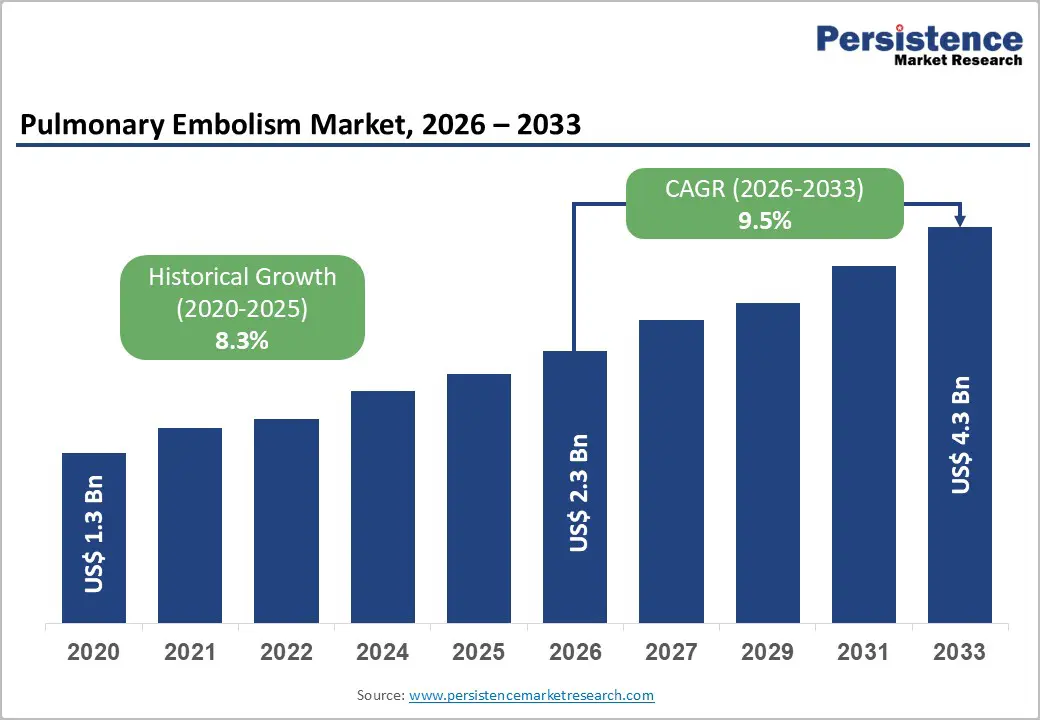
pulmonary embolism (PE) market
The pulmonary embolism market is expanding globally, driven by rising disease prevalence, advanced diagnostics, and growing adoption of innovative treatments.
LONDON, UNITED KINGDOM, April 13, 2026 /EINPresswire.com/ -- The global pulmonary embolism (PE) market is projected to expand significantly, increasing from an estimated US$ 2.3 billion in 2026 to US$ 4.3 billion by 2033, representing a compound annual growth rate (CAGR) of 9.5% over the forecast period. Growth is driven by rising incidence rates of pulmonary embolism, advances in diagnostic imaging, and broader adoption of anticoagulants and catheter-based therapies. While North America currently dominates the market due to its advanced healthcare infrastructure and reimbursement policies, the Asia-Pacific region is emerging as the fastest-growing market, fueled by increased disease awareness, enhanced diagnostic capabilities, and expanding hospital capacity.
Download Your Free Sample & Explore Key Insights: https://www.persistencemarketresearch.com/samples/34496
Key Industry Highlights
Medications are the leading treatment segment, accounting for 68.1% of the market in 2025. Anticoagulants and thrombolytics are commonly used for low- and intermediate-risk PE patients due to their clinical effectiveness, ease of administration, guideline support, and global availability. North America holds the largest regional market share at 38.0%, driven by high disease awareness, widespread use of computed tomography pulmonary angiography (CTPA), and early adoption of catheter-based interventions. Market growth is further supported by rising prevalence of venous thromboembolism (VTE), aging populations, increasing obesity and cancer rates, improved diagnostic accuracy, broader use of direct oral anticoagulants (DOACs), and adoption of minimally invasive PE treatment methods. Opportunities include expansion of catheter-directed thrombectomy and thrombolysis, development of safer next-generation anticoagulants, establishment of pulmonary embolism response teams (PERT), advanced risk stratification tools, and penetration into emerging markets.
Market Dynamics
The rising incidence of VTE and an aging population are significant drivers of market expansion. Pulmonary embolism, a major component of VTE, affects nearly 900,000 people annually in the U.S. and is a leading cause of preventable hospital deaths. Age is a predominant risk factor, with incidence rates sharply increasing among older adults. Adults aged 65–69 experience an annual PE incidence of approximately 1.3 per 1,000, which rises to around 2.8 per 1,000 for those aged 85–89. The increased risk in older populations underscores the growing clinical need for timely diagnosis, treatment, and ongoing management.
Despite market growth, anticoagulant and thrombolytic therapies carry a significant bleeding risk, which can limit their use. Warfarin and other anticoagulants have annual major bleeding rates of 15–20%, with life-threatening bleeds in 1–3% of patients. Thrombolytic therapy, used for high-risk PE cases, has major bleeding rates of 13–20% and a 2–3% risk of intracranial hemorrhage, restricting broader adoption. These safety concerns highlight the need for safer treatment options and contribute to restrained market expansion.
Opportunities in Catheter-Based Therapies
Catheter-directed thrombectomy and thrombolysis are emerging as promising alternatives. These mechanical approaches reduce clot burden while minimizing bleeding risk, especially in intermediate- and high-risk PE patients. Meta-analyses and registry data suggest lower mortality and favorable hemodynamic outcomes compared with systemic thrombolysis, with procedural complication rates ranging from 1.4–6.7%. Large-bore mechanical thrombectomy shows reduced clinical deterioration and readmission, making catheter-directed therapies an expanding segment of the PE treatment market.
Get Custom Insights Designed for Your Businecss: https://www.persistencemarketresearch.com/request-customization/34496
Category-wise Analysis
Medications dominate the PE market due to their ability to prevent clot propagation and recurrence. DOACs such as apixaban and rivaroxaban are preferred over traditional therapies like warfarin for their predictable pharmacokinetics, reduced bleeding risk, and outpatient usability. Over 80% of non-massive PE cases are managed with anticoagulants, reflecting widespread clinical acceptance. Diagnostic imaging, particularly CTPA, is the gold standard for rapid, accurate detection of PE, with sensitivity and specificity exceeding 95%. Its ability to evaluate alternative diagnoses alongside PE detection has reinforced its dominance in emergency settings.
Regional Insights
North America maintains market leadership due to a high PE burden, advanced healthcare infrastructure, and widespread adoption of diagnostic and treatment technologies. Europe benefits from standardized clinical guidelines, extensive healthcare systems, and a large aging population contributing to consistent PE management practices. Asia-Pacific shows the fastest growth, supported by expanding healthcare infrastructure, rising awareness, improved diagnostic adoption, and government healthcare reforms enhancing access to PE care.
Market Competitive Landscape
The pulmonary embolism market is moderately competitive, driven by pharmaceutical companies offering anticoagulants and thrombolytics, alongside device manufacturers of catheter-based interventions. Recent developments include Bristol Myers Squibb and Johnson & Johnson launching educational initiatives on thromboembolic care in February 2026, and Bayer’s investigational antibody BAY-3018250 entering Phase II trials in January 2025. Leading companies in the market include Bayer AG, Johnson & Johnson, Boehringer Ingelheim, Pfizer, Bristol-Myers Squibb, Amgen, Astellas, Daiichi Sankyo, Roche, Eli Lilly, Gilead Sciences, Medtronic, Inari Medical, Novartis, Sanofi, Viatris, and Takeda Pharmaceutical.
Checkout Now & Download Complete Market Report: https://www.persistencemarketresearch.com/checkout/34496
Global Pulmonary Embolism Market Segmentation
By Treatment
Surgery
Medications
Mechanical Devices
Others
By Diagnosis
MRI
CT Scan
ECG
Chest X-Ray
Pulmonary Angiography
Venous Ultrasound
Venography
D-Dimer Test
Others
By Symptom
Shortness of Breath
Cough
Chest Pain
Fever
Dizziness
Cyanosis
Irregular Heartbeat
Others
By End User
Specialty Clinics
Hospitals
Homecare
Others
By Region
North America
Europe
East Asia
South Asia & Oceania
Latin America
Middle East and Africa
Conclusion
The global pulmonary embolism market is poised for robust growth through 2033, driven by rising disease prevalence, advanced diagnostics, expanding therapeutic options, and regional healthcare development. While bleeding risks limit some therapies, emerging catheter-based treatments and next-generation anticoagulants provide significant opportunities for innovation and market expansion. North America will continue to lead, but Asia-Pacific represents a high-growth frontier with expanding healthcare access and increasing awareness.
Read Related Reports:
Scar Treatment Market: The global scar treatment market is set to grow from US$23.0 Bn in 2026 to US$49.2 Bn by 2033, registering a strong CAGR of 11.5% during 2026–2033.
Laboratory Informatics Market: The global laboratory informatics market is set to grow from US$4.0 Bn in 2026 to US$5.9 Bn by 2033, registering a CAGR of 5.8% during 2026–2033.
Persistence Market Research
Persistence Market Research Pvt Ltd
+1 646-878-6329
email us here
Visit us on social media:
LinkedIn
Instagram
Facebook
YouTube
X
Legal Disclaimer:
EIN Presswire provides this news content "as is" without warranty of any kind. We do not accept any responsibility or liability for the accuracy, content, images, videos, licenses, completeness, legality, or reliability of the information contained in this article. If you have any complaints or copyright issues related to this article, kindly contact the author above.
